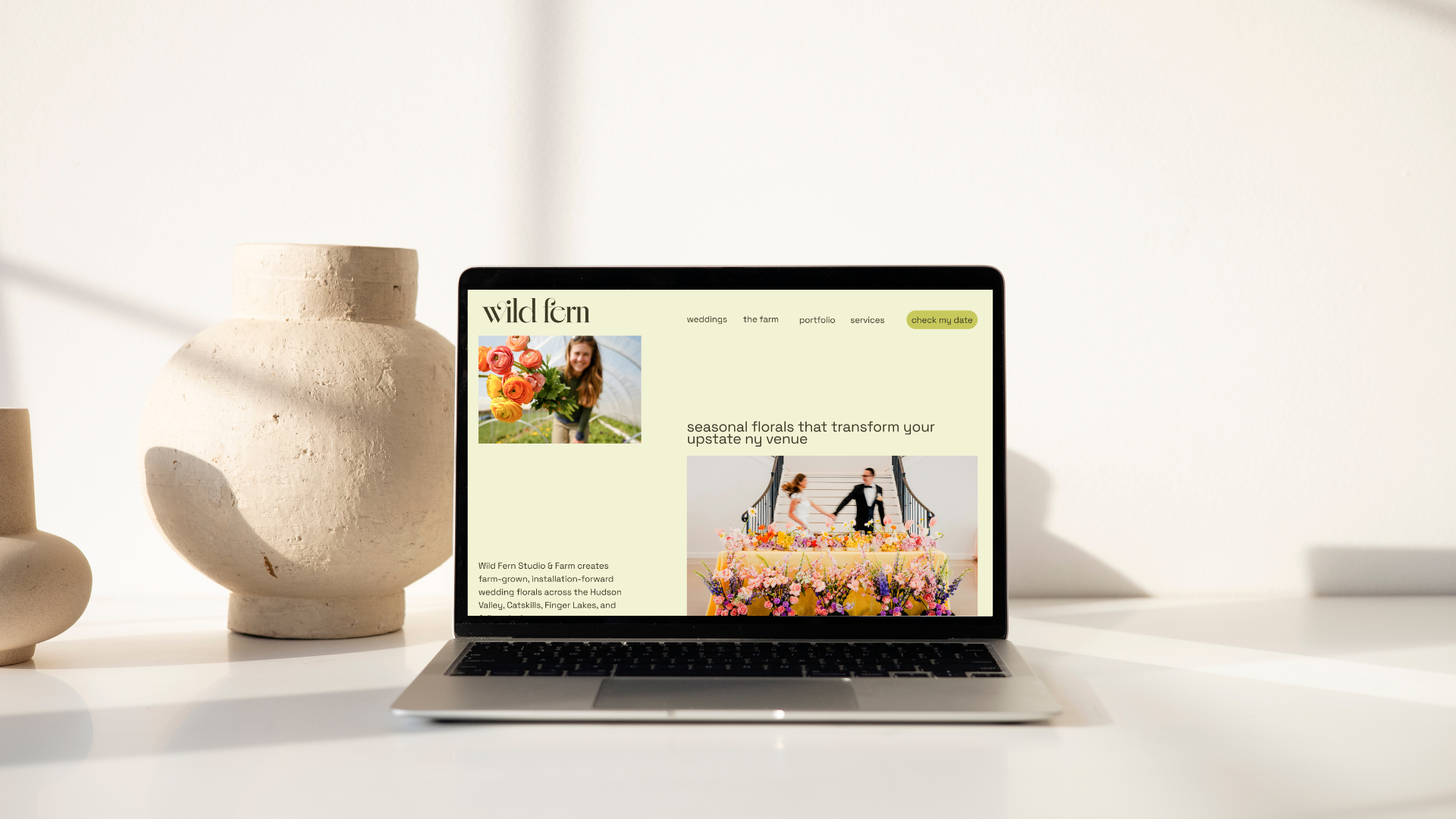
Case Study: Wild Fern
Wild Fern Studio & Farm creates farm-grown, installation-forward wedding florals across the Hudson Valley, Catskills, Finger Lakes, and Adirondacks.
Note: Wild Fern is not a real floral business. It is a brand that has been invented for the purposes of this case study. Stock Photographs by Zoe Richardson and Kari Bjorn
The Problem
Wild Fern had the kind of work that should attract higher-end weddings: seasonal, farm-grown florals, an artful point of view, and a strong fit for couples who value natural luxury. But the website wasn’t doing enough to support the business behind that work.
Too many low-fit inquiries were still coming through for peak-season weddings. Full-service and a la carte offers were not distinct enough in the user journey. And the site was not fully communicating the investment level, design process, or seasonal philosophy needed to attract clients who understood the value of the work.
As a result, the studio was spending more time spent on mismatched inquiries, had less clarity around fit, and had a website that wasn’t working hard enough as a tool for premium positioning and pre-qualification.
This project focused on reshaping the site so it could do more than inspire visually — it needed to clearly signal minimums, separate service paths, build trust fast, and bring in more right-fit full-service leads.
This wasn’t a visibility problem so much as a fit problem.
Wild Fern needed a website that could better attract the kind of full-service wedding clients they most wanted to book, while making it easier for lower-budget or lower-touch clients to identify the right offer. The strategy was to use the site not just as a gallery, but as a tool for positioning, pre-qualification, and trust-building — so the right clients felt more confident reaching out, and the wrong-fit inquiries decreased.
This website needed to…
Position Wild Fern as a premium, design-led studio-farm florist
✾
Clearly separate full-service weddings from a la carte / DIY offerings
✾
Build trust through clearer messaging, process, and fit
✾
Guide clients toward thinking in terms of seasonal palettes and overall floral atmosphere, rather than requesting specific bloom varieties
✾
✾ business objectives and metrics
Increase the share of right-fit inquiries for full-service weddings during peak season
Increase average booked event value from 4k to 7k
Decrease % of total peak season events that are below 6k to 10%
Decrease below 6k minimum inquiry rate to from 80% to 20%
Increase inquiry to booking conversion rate
Create distinct paths for full-service vs. a la carte / DIY offerings
Decrease number of a la carte / DIY inquiries entering the full-service funnel
Elevate the brand to attract higher-budget clients
Increase average inquiry budget
Increase average booked event value from 4k to 7k
Full home page layout
Branding
Wild Fern’s farm is part of the brand story, not just the backdrop. I wanted the imagery of the growing spaces to feel just as central to the identity as the finished floral designs themselves. A restrained green palette, drawn from the farm itself, creates an organic backdrop that keeps both the flowers and the landscape front and center.
Modern yet slightly whimsical typography helps position the brand as elevated, creative, and grounded in the spirit of the Hudson Valley.
Web Design
The design was created in Figma. The design process focused on translating Wild Fern’s business goals into a more intentional user journey that elevates the brand, clarifies offerings, and helps the right clients move toward inquiry.
#1 position Wild Fern as a premium, design-led studio-farm florist
The homepage hero was designed to immediately connect Wild Fern’s farm roots with its elevated wedding work. Through image selection, composition, and hierarchy, the opening experience frames the brand as both seasonally grounded and highly design-conscious. Investment expectations are also introduced clearly on the inquiry form to reinforce fit early.
#2 create distinct paths for full-service and a la carte offerings
The site architecture gives full-service weddings clear priority, while other offerings are intentionally separated into their own path. On the homepage, these services appear as a secondary option, and in the navigation they are supported with dedicated pages. This helps visitors quickly understand which experience is right for them.
#3 build trust through clearer messaging, process, and fit
Because Wild Fern’s work is shaped by seasonality and what is growing on the farm, the site encourages clients to think in terms of color palette and overall feeling rather than specific flower varieties. A seasonal palette feature helps introduce that mindset before inquiry, leading to more aligned and productive conversations.
#4 reinforce a seasonal, palette-led approach to floral planning
The homepage was structured to answer the questions many potential clients have before they ever reach out: what Wild Fern offers, who it is best for, and what the experience of working together might feel like. The combination of imagery, messaging, and layout helps the brand feel more transparent, considered, and trustworthy from the start.
Web Development
This concept was designed with Squarespace in mind, but could be implemented on any major web development platform.